
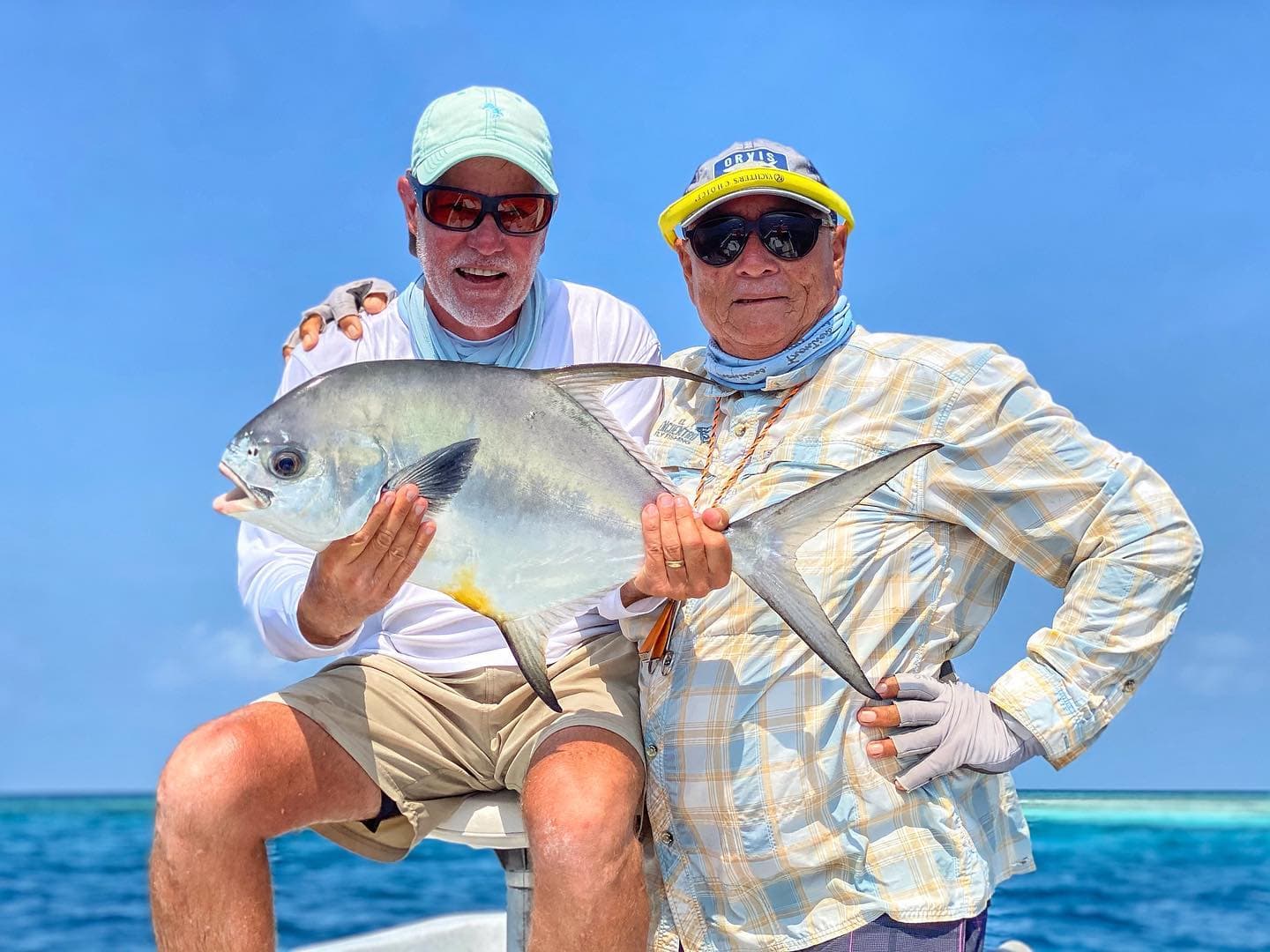
Before Charlie Leslie guided visiting anglers across Belize’s flats, he learned the sea alongside his father. Before he built his own fishing business, he captained boats for someone else, maintained hulls and engines between seasons, and went lobster diving when guiding work ran out.
His story belongs to that working world: boats that needed constant attention, opportunities that came unevenly, and knowledge passed between people whose livelihoods depended on getting things right.
It also includes a young man who returned to Placencia to teach, a cargo voyage that ended in prolonged detention in Guatemala, and an independent guide who remembered borrowing a fuel tank and money for fuel to get his business moving.
Across those different chapters, Charlie kept learning. One of his most revealing lessons came when he put on a mask and lay in shallow water to watch permit feeding. To explain the fish to an angler, he first wanted to understand what was happening beneath the surface.
Learning from Liston
Charlie grew up in Placencia, the son of Doris and Liston Leslie. His father was a commercial fisherman who lived and worked at Ranguana Caye and later the Sapodilla Cayes.
In his recollections, Charlie returned to his father as the source of his earliest practical education.
“It was with my father that I learned everything about fishing and working the sailboats,” he recalled.
Fishing and handling a boat were connected responsibilities. Finding fish was only part of the work. There was also the business of travelling between places, working offshore and bringing a vessel home.
His mother hoped for another kind of future for him. The manuscript records that Doris wanted him to gain an education and return to Placencia as a teacher. Charlie attended high school in Belize City and did come home to teach.
Teaching did not become his lasting profession. Yet explaining things to people would remain central to his working life. Years later, on the flats, he would again be asking someone to listen, practise and try to understand what they were seeing.
The work behind a fishing trip
Charlie’s early employment with Fred Keller’s fishing operation began with captaining a larger boat that carried guides and anglers out to smaller fishing skiffs.
The responsibility came before his own opportunity to guide. When he moved into guiding, he worked along the Belize River and in nearby offshore waters. His experience widened through liveaboard trips alongside other Belizean boatmen, including David Wesby and Captain Leroy Eiley.
Charlie recalled trips aboard the Christian lasting eight to ten days. A captain, guides and cooks supported a small group of anglers for the journey.
For visitors, those days were a fishing holiday. For the crew, they were an extended period of shared work. The trip depended on people with different responsibilities doing their jobs aboard the same vessel.
Guiding also had a season. Charlie described a working year in which the visitor fishing season was followed by maintenance: hauling skiffs out, repainting and recaulking hulls, and servicing or overhauling engines.
When that work finished, he went lobster diving with Captain Eiley aboard the Helen E., a boat built by Eiley’s father.
The next guiding season was something to hope for. Charlie remembered diving through the intervening months, then waiting for Keller to call them back.
That pattern helps explain the breadth of his experience. His livelihood required more than the ability to put an angler near a fish. He needed to understand boats, adapt to different work and find a way through the months between bookings.
Seven months and a day
One job away from guiding became a particularly difficult chapter.
In the account preserved with his recollections, Charlie joined a tugboat crew transporting cargo between Guatemala and Belize. A barge sank during the voyage. What followed, he recalled, was a prolonged ordeal involving court appearances, imprisonment and other periods of confinement in Guatemala.
He described illness during detention and uncertainty over when the crew would be allowed home.
The surviving manuscripts contain inconsistencies in their dates. The experience is therefore best presented as Charlie’s account, without imposing a precise chronology that the available material does not securely establish.
The duration remained clear in his telling: seven months and a day.
He also remembered the reception when they finally returned to Belize, with people gathered at the airport and in Belize City.
This episode was a substantial interruption to his working life. His story continued beyond it, with the familiar need to earn a living and the growing ambition to establish an operation of his own.
Starting with a boat and borrowed fuel
Knowing how to guide did not give Charlie the money to start a business.
He needed a boat and an engine, fuel to take clients out, and enough work to keep the operation going. In his recollections, he described approaching banks and credit unions without the collateral needed to secure a loan.
He went to the United States to work and save.
Eventually, he bought a boat and brought it back to Belize. He remembered putting his remaining savings into a 48-horsepower Yamaha outboard, then borrowing a fuel tank and money for fuel so he could begin taking clients fishing.
The detail matters. A boat and an engine were essential, but they were still not quite enough to make the first trip possible.
Back in Placencia, Charlie operated from his home and wrote to anglers he had guided before. These were people who already knew him and had spent time with him on the water.
Letters brought replies. Some replies became bookings.
Kingfisher Adventures developed through those relationships, alongside opportunities to guide visitors staying at local hotels. Charlie also described running a small bar called Hilltop for a period, another way to supplement his income while continuing to guide.
His recollection of the Kingfisher name places its inspiration on the Monkey River. He was fishing with a client in light rain, with howler monkeys in the riverside trees, when a kingfisher flew low over the boat. The bird gave him the name he would keep using.
The manuscript’s boat numbering does not establish exactly where that moment falls in the business’s beginnings. The memory itself is more straightforward: a name drawn from a bird encountered during a day’s work on a Belizean river.
A captain prepared to wait
Charlie’s boats also carried passengers between Placencia and Honduras.
Julian Monroe Fisher, who later recorded Charlie’s fishing recollections, first knew him through that service. Fisher remembered waiting in Placencia while persistent rain delayed a crossing aboard Kingfisher II.
Charlie watched the conditions and kept the boat in port.
When they eventually departed, the route took them through the mangroves to Big Creek for departure formalities, then across to Puerto Cortés.
Fisher also recalled Charlie helping him after arrival, arranging transport and making sure he could continue his journey.
The account offers a view of Charlie beyond a fishing trip. His responsibility extended from deciding when to leave to helping a passenger find his way at the other end.
It also records a decision that is easy to overlook in a story about a captain: sometimes the work was waiting.
Learning to see beneath the surface
Charlie credited other anglers and teachers with helping him develop his fly-fishing skills, particularly Mel Krieger and Lefty Kreh.
He was candid about not immediately embracing fly-fishing. In his early assessment, it looked like demanding work for both the angler and the guide. Experience changed his relationship with it, although he continued to describe it as hard work.
His own observations became an important part of what he taught.
To study permit, Charlie recalled putting on a mask and lying on the flats to watch them feeding. From beneath the surface, he could observe fish disturbing the bottom, moving around a feeding spot and searching for food.
Those observations shaped the instructions he gave an angler.
A fly needed to reach the place where the fish was feeding. It needed time to sink. Its movement needed to make sense in relation to the food the fish was looking for.
Pulling it away too quickly could undo a good cast.
This was practical reasoning developed through observation. Charlie was trying to connect what the angler did above the water with what the fish encountered below it.
He also understood that an angler might struggle to see the fish at all.
His response was to break the task into steps: direction first, distance second. From the boat, he used a clock face to establish direction, then guided the cast with adjustments to the left or right.
What looked like a brief instruction could contain several separate judgments: where the fish was, where it was moving, what the angler could see and what correction they could make in time.
Understanding the person holding the rod
Charlie paid attention to the angler as well as the fish.
He described how the sight of a permit could unsettle someone who normally cast well. Excitement changed the moment. The person who could make the cast in practice might struggle when the opportunity appeared.
The guide’s response mattered.
Charlie believed in helping the angler stay calm. He also acknowledged his own frustration and the need to control it. Wanting someone to catch a fish did not make impatience useful.
He could be direct. If a person needed more casting practice, he believed in telling them and spending time on it.
His account of guiding makes the relationship a shared effort. The guide had to find the opportunity, explain it and support the angler. The angler had to listen and make the cast. Neither could complete the other’s part.
That is where the different strands of Charlie’s life meet: the practical education received from his father, the responsibility learned aboard working boats, the persistence needed to establish a business, and the patience required to help another person learn.
His story gives a human history to knowledge that a visitor might otherwise hear only as a few instructions from the back of a boat.
Behind those instructions were years of work, mistakes, observation and decisions. Behind the guide was a son of Placencia who had built a life around understanding the water and helping other people find their way on it.